Thursday, November 26, 2009
Scientology is a Leaking Vessel
Now, with legal cases in France, Australia and Belgium, continuing allegations about the violence at the heart of the church, a parade of high-ranking whistle-blowers, and the church's public exposure of parishioners personal files, members might be beginning to wonder exactly what kind of beast it is that they've signed up for. Grahame has posted a shocking link to a story about what Volunteer Ministers are doing in Samoa. We've heard stories before of how the VMs will visit disaster-struck countries in order to help with the relief effort; handing out Um Bongo to fire-fighters, that sort of thing. Some will even discuss VMs training medical professionals in their own brand of hands on healing "touch assists".
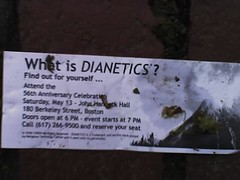
It seems that their usual level of reserve, however, has been abandoned. Now VMs are openly admitting that they find people who have been traumatised by disaster and teach them Dianetics. In an attempt to quell the criticism being levelled at the Church in Australia, they believe that demonstrating how they target people in crisis in order to promote their religion is something worth shouting about. So do we! This is not something that is going to win support from outside the Church, if anything it confirms what people may hitherto only suspect; the only benefit is to repair some of the damage the brand has sustained in the eyes of scientologists, and allow the Church to keep its hooks in its existing parishioners.
Mark Fisher has suggested that Miscavige has set up a task force to re-recruit departed members, which also makes it plain that the Church is struggling to maintain its paying customers. In the past, apostates would be disconnected, written off as lost causes, something the Church could afford to do because there was always fresh meat to be had. With over a year of Anonymous protests, the worst press the Church has had in decades, high profile defections, unwitting admissions of dodgy practices, and more, the "bodies" are now more innoculated against Hubbard's trap than they have ever been, and it is the best that Miscavige can do to stop the bubble bursting.
| I'd like |
Friday, November 20, 2009
BHA Billboards and the Multi-Faith Irony
The previous campaign "There's Probably No God..." drew fire from many sides, but the current campaign is much trickier ground. The BBC, whose journalism tends to seek out and occasionally manufacture conflict, found Graham Coyle, of the Christian Schools Trust:
This is largely blether, because it falls into the mistake of thinking that morality is based on religion, when clearly religion just formalises the morality that emerges from society. That's why we don't stone kids and rape victims to death so much these days.They seem to be saying that they don't want parents to pass on to their children their fundamental beliefs - about what is right and wrong, about respect for other people and living in harmony, ...
If that is what they are saying then they are asking parents to abrogate their responsibilities. And if parents don't pass on these beliefs who is going to fill the vacuum?
To say that we are labelling our children by passing on our fundamental values is mistaken.
The thrust of the campaign isn't to attempt to bring up amoral monstrosities, but to bring kids up in a loving environment where they can encounter various religions and, when they are old enough, to write out their own religious label.
What I love about this campaign, though, is that it is much harder to argue against. It exposes, whether intentionally or not, the lie at the heart of interfaith relations. Stephen Green puts out a pamphlet entitled "Winning Muslims for Christ". I'm neither a Muslim or a Christian, but the existence of this title offends me. That said, it is a more honest position for the faithful to take. The notions of interfaith exchange is this "Let's all get along (but inside we know you're wrong)." and that's the button that the BHA campaign is pushing - it is asking the faithful to risk the salvation of their kids for the possible salvation of other people's kids, those idolatry types who are very nice and all, but are sadly mistaken. Few faithful people wish to speak too loudly against a poster campaign that may lead someone to their god.
The path to my own atheism involves in part this dilemma. Dawkins goes on about pantheons that have long-slipped from the religious focus of man, the Thors and the Zeuses. We tend to adopt the religions of our parents first and foremost, so our religious convictions, unless we have the strength to break free from it, are a product of when and where we are born. The salvation of human kind is a postcode and epoch lottery.
| I'd like |
Wednesday, November 11, 2009
Adverse Events
CCHR anti-psychiatry pamphlet from Wikipedia
I've followed for some time My Scientology Blog, which is a vital source if you're interested in how Scientology chooses to present itself to the world at large. I'm not sure whether its author, Grahame, is fulfilling some kind of OSA detail or whether he is simply a public Scientologist, but either way he tends to present the Church's standard line on most matters. He also responds to questions. I genuinely admire Scientologists, and for that matter people of any faith, that keep the channels open. If they're willing to discuss their ideas and beliefs then they are willing to test them, and are more likely to be in a position to test other people's beliefs. This can only be progressive. It is true, though, that Grahame does have the odd infuriating habit. He will avidly wave about the expansion figures that the Church of Scientology puts out, for instance, but will not question them, or even why they were released not to the world media, but in the magazine sold to existing Scientologists; not to convince the world at large that the church is not in trouble, but to convince the "base" of paying and obeying true believers.
But I digress.
Someone recently asked the following of Grahame:
This led to Grahame responding in detail about the difference between illegal drugs, medical drugs, and legal "every day" drugs such as nicotine and alcohol. This all seems fairly reasonable and sensible, despite him lumping in chiropractors and nutritionists with proper doctors, and later on admitting that he entertains the administration of discredited nineteenth century pseudoscience homeopathy. But he goes on to talk about drugs that are legal, but nevertheless "have been proven to be dangerous and to cause harm but are still on the market because the drug manufacturer makes billions from them". Familiar territory in these dark antivax days. To identify these he directs his readers to a Citizens' Campaign for Human Rights site. Avid readers will know that CCHR is a front group of Scientology, integral enough to the Church's grand mission to rid the world of psychiatry that they are mentioned in high management strategy documents.
I know Scientology opposes the drugging of society, but I am unclear as to precisely what extent it stands in opposition to drug consumption, i.e. absolute opposition vs. nuanced opposition.
What, if anything, does Scientology have to say, for example, about "moderate" caffeine and/or alcohol consumption? Are Scientologists discouraged from drinking beer and caffeinated soda?
The site consists of a searchable index of data culled from the FDA's Adverse Event Reporting System as it relates to various "psychiatric drugs" and lists adverse reactions relating to them. It's worth pointing out, and in fact the FDA do so, that these are medical events that have occured to people while taking medication. A reported adverse event does not demonstrate that the event was a reaction to the medication, and the reporting of them is to create sufficient anecdotal evidence to legitimise research into determining whether the drug was the actual cause. The CCHR, however, demonstrate no sense of caution, and are much more likely to leap to the conclusion that it was the meds what done it. As their site states:
The Oxford English Dictionary defines a poison as "a substance that causes death or harm when introduced into or absorbed by a living organism." These psychiatric drugs fit that definition.That makes the following, perhaps a coincidence, perhaps not, worrying and potentially illuminates the sad fate that befell Jett Travolta. As reported in the LA Times, Jett was taken off anti-seizure medication because it had ceased to work. This may be true - people who suffer from seizures do adapt to their medication and will often have to switch from time to time in order to stay one step ahead of their condition. That would sit more comfortably were it not for the fact that Jett's medication, Depakote, is featured on the CCHR site, along with a long list of adverse events. So is the Church of Scientology for it, or against it? Grahame?
Thursday, November 05, 2009
You're Ill! POW! You're Cured!
Here's Healthy Life Essex on the subject. Note that they offer up DITI as a means of avoiding problems inherent with mass screening programs, despite the fact that the problems of mass screening aren't based on the technology as such, but what happens to the numbers of false positive and false negative results when applying the technology to a large number of people.
Here's Whollistic Medicine's penny's worth, too, complete with technical looking thermal pictures of some boobs. Whollistic tell us that "An abnormal infrared thermal image is the single most important marker of high risk for developing breast cancer, much more so than a family history of breast cancer." Pretty serious and useful technology, then?
Well, a search of Pub Med for the terms "digital infrared thermal imaging diagnosis breast cancer" came up with a grand total of four studies. One looked solely at women who had reached the biopsy stage and suggested that DITI is "a valuable adjunct to mammography and ultrasound, especially in women with dense breast parenchyma."
A second dealt with the technology itself. A third looked at the use of DITI in monitoring tumour growth in nude mice. Success with our mammalian cousins led the researchers to conclude that "thermographic imaging might have considerable potential in monitoring human tumor xenografts and their response to anticancer drugs." A fourth, dating back to 1998, discussed technological advances and suggested DITI may be useful. It is rational conjecture, but does not reflect clinical research into the use of DITI as a diagnostic tool.
I was a little over-selective in my search terms, and there exists more research out there, but nothing I've turned up makes the suggestion that DITI can detect cancers a decade before more established methods. Perhaps I have overlooked them; but do keep in mind that DITI only really started making a comeback in the 1990s, which doesn't offer very much possibility of such research existing. One would need to run a trial whereby women were routinely screened (proponents of DITI look for changes over time in scans as a means of detection), the "signature" of breast cancer identified retrospectively, and then for it to be applied in practice on a further trial group to establish the efficacy of the diagnostic procedure.
But the practitioners offering DITI as a diagnostic tool aren't all that bothered about evidence. The Essex article refers to practitioners Billy and Wendy Bradford, who run the Beechwood Clinic, Cambridge. £175 covers your "baseline" scan and 90 day scan. You're then charged a further £175 a year. Annual scans are, of course, advised. Other services on offer are reflexology and Indian Head Massage.
Whollistic Medicine is run by Dr. Shamim Daya and also offers acupuncture, bio-identical hormones, flower therapy, and Electro-lymphatic therapy (which runs on inert gas and quantum mechanics).
Here's a chiropractor offering DITI.
Here's a homeopathist offering DITI.
You get my point.
But what I find most interesting about this is the unique marketing opportunity DITI poses for CAM. We use phsyical examination, mammography and biopsy to detect cancers. Infrared Imaging claims to pre-empt this process by a decade, and it is being sold by people who are willing to make claims about treatments for which there is no evidence of efficacy.
So say someone undergoes DITI scanning and is told that they should see their GP as the scan suggests they have cancer. Note that, strictly speaking, practitioners themselves can't diagnose. The customer goes to their GP who, understandably, cannot detect a cancer. DITI operators trade in "peace of mind". That's why the scans are targeted at younger women (well, that and the Kylie effect) for whom mammography isn't a very good test. DITI offers the comfort of a "certain" negative result.
But if someone tests positive, then they are stuck. No medical doctor will treat a cancer that isn't there. So if the customer is "refused treatment" their first port of call will no doubt be the DITI clinic, who will then be in the choice situation of treating a cancer that isn't there with medicine that doesn't work.
They say the perfect con is one where the mark never realises he's been duped, and maybe even feels better for it. When you allow practitioners to diagnose cancers no-one else can detect, and then allow them to offer treatments for them, and can even have those treatments appear to work, then you have pretty much achieved perfection.
EDIT - It appears that most, if not all, machines used in private practices for this kind of diagnostic work are produced by an American company called Meditherm. Their site has an impressive list of studies demonstrating the efficacy of the technology. Of the few that refer to cancer, most are looking at its use in monitoring known cases of breast cancer, and therefore not about the efficacy of its diagnostics. One, however, really did catch my eye, namely Thermography in screening for breast cancer (K L Williams, B H Phillips, P A Jones, S A Beaman, and P J Fleming, 1990). This is exactly the kind of trial I'm interested in seeing, as it looks at the correlation between patients presenting abnormal thermal images, and them going on to develop breast cancer. It has a decent sized sample of 10,238 women, and followed them over a five year period. It found that "71.6% of the women who developed breast cancer had had a normal thermogram at the time of examination, as did 73% of those who did not," and concluded "Thermography is not sufficiently sensitive to be used as a screening test for breast cancer, nor is it useful as an indicator of risk of developing the disease within five years."
Now, this study took place prior to 1990, and it was only really after 1990 that technological advances led to people looking again at the technology, but sadly there does not appear to be any trial similar to that by Williams et al, and without that we don't really know whether it works. What does bother me, however, is that this trial, disproving the approach, is slipped in, unlinked and out of context, into a snowball style bibliography that is supposed to convince people less anal than I that DITI is a worthwhile pursuit. This amounts to sloppiness or a deliberate attempt to mislead.
| I'd like |
Monday, November 02, 2009
The Complementary and Natural Healthcare Council (CNHC) received £900,000 of state funding in order to set up as a voluntary regulatory body for complementary and alternative medicine (CAM).
Their initial 2009 target for membership was 10,000. This was later reduced to 4,000. As it currently stands the Council have attracted little more than a quarter of this (1,029).
It seems that there is a deep philosophical conflict here. The main goal of the CNHC is to create a sense of respectability and legitimacy for alternative medicine. However this can only be achieved if the organisation puts in place a code of conduct that emphasises a level of honesty and openness about its medical claims, and the adoption of disciplinary procedures for practitioners guilty of misconduct.
Much of complementary and alternative medicine not only lacks an evidence base showing efficacy, but has a large body of evidence demonstrating a lack of efficacy. Practitioners are therefore unlikely to sign up to a a code of conduct that may forbid making unproven claims, facing up to the evidence that their treatments are ineffective, or encouraging patients to cease conventional treatments (there is a strong belief in CAM that conventional medicine is damaging). This seems to be borne out by the CNHC's figures, and it is no accident that the organisation has been most popular with massage therapists, a field that makes much more modest claims than chiropractors and acupuncturists.
It's also worth comparing CNHC to organisations such as the British Chiropractic Association. It too offers a veneer of respectability, but its code of practice chiefly concerns not bringing the BCA itself into disrepute; as this is the case, one must ask what the BCA is actualy for, and what it offers its members beyond the use of a logo.
I am writing to ask for some kind of assurance that, should the CNHC fail to meet their targets this year, it will be considered a sign that there is no market for a self-regulatory body for CAM, and that they will not be in a position to receive further funding.
Yours sincerely,
********
Tuesday, October 27, 2009
The French Verdict
There will now inevitably be a washing of hands; we know this, because we have been here before. Karen Pouw or Tommy Davis will explain that the French trial reflects the actions of a few bad apples, inevitable in any organisation, and that they would be rooted out (indeed, routed out) and expelled. If such statements are made, let's recall a couple of points.
Firstly, the actions that led to the trial are not practices that are peculiar to a few malicious church members. As CNN reports,
the plaintiffs focused their complaints on the use of a device that Scientologists say measures spiritual well-being. Members used the electropsychometer, or E-Meter, to "locate areas of spiritual duress or travail so they can be addressed and handled," according to Scientology's Web site.
The plaintiffs said that, after using the device, they were encouraged to pay for vitamins and books. They said that amounted to fraud.
So the fraudulent activities of the Church involved offering personality tests, falsely diagnosing personality defects, and then selling books and vitamins to correct those defects. They invent a problem, and sell a fake remedy to alleviate it. These are the standard business practices of the church, not some Slatkin-esque Ponzi scheme wicked staff members were running on the side.
The second thing to point out is that although society at large has deemed Church staff out ethics, they are not going to be viewed as out ethics within the church (beyond the high crime of getting caught). This echoes Operation Snow White, where a large number of church members were found guilty of breaking into federal buildings with an aim to destroy records. Following the verdict, we were told that those involved, many of whom were high-ranking Church members, would be expelled, but they were not expelled.
The French trial ruled that the Church not be dissolved, but that it could only continue within the law. It will be very interesting to see whether such a restriction, considering how the law has been defined in relation to the Church's commercial practices, will become a de facto order of dissolution any way.
UPDATE
Well I couldn't have been wronger! Tommy Davis has now played the "religious freedom" card instead. I guess the question, then, is whether or not religious freedom should mean "free to break the law".
| I'd like |
Thursday, October 15, 2009
Being Normal
But really I'm not all that concerned either way in gut flora and the reality or otherwise of the healthy benefits of probiotics. What does concern me, and this has been commented on by better brains than mine, is the way these claims and ideas and behaviours are being normalised in the lives of children.
Now, it is fine to teach children of the importance of nutrition, that they will be healthier if they enjoy a varied diet and eat lots of fruit and vegetables. What is not fine, however, is to over-medicalise food. Actimel is a yogurt. Here's how it's marketed.

It's given a small unique portion, and the caveat, which not only manages to conflate any effect it might have with the effect of having a properly balanced diet, is reminiscent of doseage instructions, and most obviously of all there is no information on the actual eating experience. Nothing about flavour, consistency, product colour... I have no idea what Actimel is like beyond that it comes in little white bottles.
But that's all fine, if you're peddling this stuff exclusively to grown adults who ought to know better. It gets a bit more sinister, though, when the target market is children. Kids don't know that we, as a race, have survived in all manner of conditions and environments without the need to specifically target their intestinal flora. If a well-meaning mother turns around and teaches her child that they need a pot of gloop a day then it will be taken on board. It will be normalised. And it's that that is so concerning, that sense that these companies are getting to people when they're young, laying the foundations for future, on-going, relentless, lucrative behaviour.
The Durham fish oil "trials" are another example; little more than a science hoax about the impact of taking a pill on a child's school performance that normalises the taking of supplements; to start each morning with a bowl of all-bran and three pills. That's the consequence, intended or otherwise, of the "smart pill" phenomenon, to teach children that the normal way of living involves popping pills. Goldacre makes the point that in many of these cases, the pill is there not even to solve or benefit the individual in a particular way, but to solve a social ill. If you take this pill three times a day, you'll manage to get your school out of special measures.
And finally, that is the consequence of kiddy chiropractic, and a plausible motivation for chiropractic practitioners to promote spine manipulation as a treatment for colic, sleeping and feeding problems, frequent ear infections, asthma and prolonged crying. Chiropractic treatment, with its belief in interrupted flows of innate intelligence, is a form of alternative medicine; by seeking out children to treat, chiropractics can normalise their treatments, safeguarding future custom.
![Reblog this post [with Zemanta]](http://img.zemanta.com/reblog_e.png?x-id=019a4b23-f597-448d-ac76-e27a100293b1)